


Expensive but fantastic rifle (updated review).
Walther LG500 Monotec
Introduction: I haven’t shot all the top 10 meter guns. I have an older FWB and that was nice. I had a Hammerli for a while but don’t remember it. Back in the stone ages I had a Diana 75 side-lever recoiless rifle – that was pretty clunky but had a few innovations for the time. The FWB 603 was nice but cocking it eventually took its toll. None of the older guns can match the ergonomics of the current guns. I can only really compare this Walther LG500 Monotec-E with my Anschutz 9015 FT that I modified for 10 meter..
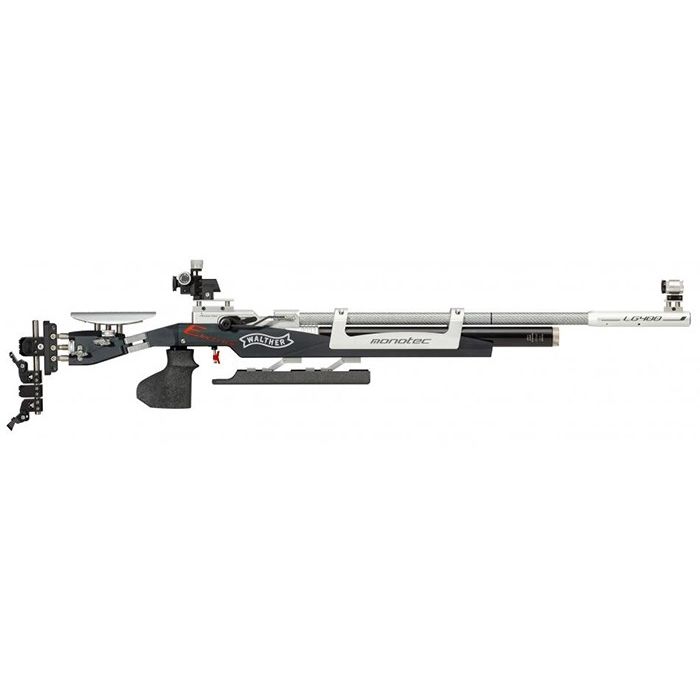
Appearance: Nice. The carbon fiber barrel wrap is striking. The logos are not overdone and the stock looks more like a rifle stock than a skeleton. This is an attractive 10 meter rifle, especially from an angle that doesn’t accentuate the large protruding cocking lever.
Barrel: Through the bore scope this barrel has the remarkably smooth, liquid-metal, mercury-like finish that is present in the “Gold” barrel of the LP500 pistol. Flawless. Maybe that is why the test target looks like the company cheated and just shot one pellet – you couldn’t really tell it is 5 shots except the edge of the hole is a little smoother than expected.
Trigger: Unlike the LP500 electronic trigger this one came perfectly adjusted – I didn’t have to change a thing. It is very smooth and on par with or perhaps a little better than the mechanical trigger on the Anschutz 9015, which is very good. It takes a little while to learn to get in the habit of turning on the electronic trigger by squeezing it before proceeding to cock and load. If you cock and load without pre-squeezing the trigger your first shot will have a very long, infinitely hard release. I had one quibble with the trigger – no trigger guard. It is easy to accidently discharge this gun. There is a very nice red bar that appears on the loading plunger when a pellet is in the chamber, this helps with some things but it doesn’t prevent accidently bumping the trigger.
I didn’t try to adjust the trigger on this gun. The Walther electronic trigger on the LP500 was difficult to adjust. I hope this one is better, if I ever have to change it.
Battery longevity remains an unknown. The barrel looks like it will last a lifetime. The air cylinders are good for 20 years but will one be able to get a replacement battery or electronic trigger in 20 years? I think I am going to buy a mechanical one that can be installed in the future.
Last but not least: the trigger can be easily charged. Unlike the Walther LP500 pistol with the electronic trigger, you can easily access the mini-USB charging port.
Sights: Why do these gun makers have proprietary gun sights? The front sight groove is 9 mm not 11. The Centra Block Club riser system that comes with the gun has a narrower groove corresponding to this width. Unfortunately, when I went to add a small riser below this riser it wouldn’t fit. Can’t we just all agree that the standard should be 11mm? The Centra Score front sight also didn’t have any additional inserts but what they had was fine for me. The Centra Block Club riser system had 4 extra 4mm pins allowing one to raise the front and rear sights just 4mm (each sight takes 2), another 4 would be useful for those of us with big, fat heads. The rear sight had nice, smooth, positive clicks. Oh, another gripe – why doesn’t the rear sight include a rubber eye shade?
Loading: There is this monstrously big cocking lever sticking from the right side of the gun. It generates enough leverage to open the breech on a 155 mm howitzer. It can easily be moved to the left side for left handers. It looks ugly but is smooth and snaps neatly closed. I find loading into the pellet groove difficult and dropped more pellets and got more in backwards than with the Anschutz 9015 where you shove the pellet into the breech.
Firing sensation: The trigger is very smooth and light and there is no, none, nada, perceived recoil. I don’t notice much recoil with other 10 meter guns either, except perhaps a little with the 9015 because it is field target rifle with much more power. But in the land of the recoilless guns this gun this one is king. This seems to help a little with follow-through but this is a subtle thing.
Balance: Out of the box the Walther was nicely balanced, with the center of gravity a little ahead of my support point. The steel cylinder that comes with the gun weighs 792 grams. It feels like a lead pipe, good in a street fight. I thought this would unbalance the gun so I was ready to order the aluminum cylinder. But, after shooting, I decided that the steel cylinder actually helped the balance. So.. money saved. The steel cylinder takes up to 300 bar, not the usual 200 bar, and will allow 600 shots. I didn’t test this. I wonder if that high pressure is good for the longevity of the regulator and seals particularly if you leave the cylinder on the gun for long periods. The steel cylinder is good for 20 years (with an inspection at 10 years) twice the life of an aluminum cylinder.
I have a Walther LP500 pistol but the cylinder uses a different fill adaptor. Why? Now I need an extra yoke and maybe scuba tank for each gun and also one for the Steyr. It would be nice if there were a standard for these air cylinders so they could all use the same adaptor.
Stock: I like this stock better than my Anschutz 9015 “ONE” stock. You can basically achieve the same infinitely variable stock configuration but it is easier to find the correct screw to loosen to move a part. I like the adjustment wheels for stock length and cheek piece height. The locking system for those adjustment wheels are also classy. I also like the decision to use all hex cap screws instead of a mixture of Torx and hex screws on the 9015. The important screws are robust, taking a 4mm hex key not wimpy things that will easily strip when tightened repeatedly. The butt plate also clamps more tightly and doesn’t come loose and rotate. My 9015 does have a butt plate hook that I miss on the Walther.
The Walther cheek rest is larger, smoother and allows the shooter to choose between a gently curved surface (my preference) and a straight surface for hard, tough guys. This is quite unlike the angular wood splinter affixed on the Anschutz which is truly masochistic. I had one quibble. I can’t get the cheek piece locked down, although the screws are tight it still rotates some with pressure.
One thing that I like a lot about both rifles is the ability to offset the stock to the right (or left) due to a hinge at the point where the stocks are attached to the rifle. I think the Walther is easier to adjust but I wish this feature were present on all stocks. It is much easier on my neck and I don’t have to cant the rifle to get a perfect sight alignment – well worth the cost of getting the stock with this adjustment – well at least if you want a comfortable shooting position you can hold all day long.
Pistol grip: The grips on both guns slide back and forth easily. They rotate but I don’t see much value in that. The Anschutz is a nice smooth piece of walnut and the Walther is wood with their textured black paint – nice for gripping and kindda sparkly.
Foregrip: The Anschutz foregrip is attached to a collar that can rotate around the carbon fiber tube holding the air cylinder. It is easy to slide this back and forth and cant the rifle if you want. Both guns have a hinge system that allows the foregrip to swing down 2-3 centimeters. The foregrip on the Walther is slightly larger. The Anshutz can be adjusted up and down with a single Torx screw. The Walther requires loosening and tightening 4 hex screws.
Pros:
Esthetically pleasing design
Flawless, polished barrel
Great trigger
Good balance
Nice sights and adjustable riser
Easily adjustable ergonomic stock
Stock can be offset right or left
Best recoilless system
Cons:
no trigger guard, easy to accidently discharge
proprietary front sight rail
needs more elevation pins with adjustable riser
cheek piece rotates even though screws are tight
somewhat difficult to load (maybe just me)
Overall: 5 of 5 stars. Nice gun.