





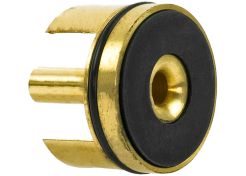
What is an airsoft cylinder?
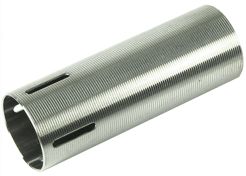
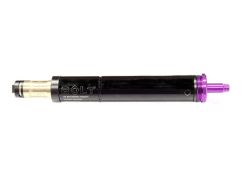
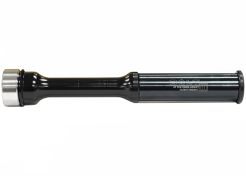
Inside the cylinder of an airsoft replica, the piston slides up and down. In this pumping action, air is compressed, just like in a tire pump. This compressed air is pushed through the cylinder head and nozzle, to propel a BB out of the barrel.
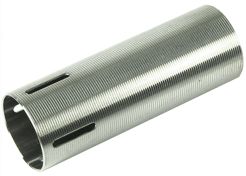
Airsoft cylinders are often made from aluminium, stainless steel or brass. Some feature external ribbing for extra heat dissipation and/or feature a Teflon coating inside for less friction. They feature a removable head.
What is an airsoft cylinder head?
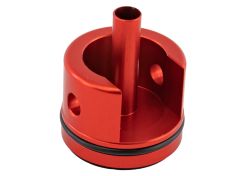
The airsoft cylinder head is the top/front of the airsoft cylinder. It’s pushed inside the cylinder and one or two O-rings provide an airtight seal. Externally, the cylinder head has a protruding tube onto which the nozzle has a sliding fit for the best possible air retention.
Airsoft cylinder barrel ratio
The cylinder-barrel ratio is a well-known subject in airsoft circles, but it has yet to be completely comprehended. What it means is the ratio between the air volume inside the cylinder and the air volume inside the barrel. The cylinder must contain enough air to push a BB completely out of the barrel. Too little air will result in a loss of speed and reach. But too much air will create turbulence, by blowing around the BB when it exits the barrel. This will result in a loss of accuracy.
The ratio between the air volume of the cylinder and the barrel can never be one to one, as the air needs to be compressed to propel the BB with force. This means that the air volume of the cylinder should always be greater than the volume of the barrel.
The balance between these two is what’s called the cylinder-barrel ratio. To make things difficult, this ratio is not set in stone. It varies, depending on the barrel length, the weight of the BB and the power of the spring, amongst others. On average, the cylinder-barrel ratio averages around the 2:1, where the cylinder has twice the volume of the barrel.
Most airsoft cylinders feature one or more slots or holes. These make sure that the air behind the piston head can be pushed out swiftly when cocking the piston, while they also help with preventing a vacuum behind the piston when it shoots forward. In both cases, resistance is reduced, making for a quieter cycle, less battery drain and more power.
As the piston head passes the holes when cocking, the piston has less resistance when it speeds up on the compression stroke. Mass inertia will then provide more power. So please remember that only when the piston head has passed the holes, the air will be compressed. This means calculating the volume is done with the bit of cylinder length between the cylinder head to the first hole. The rest of the cylinder length has to be discarded in the calculation.
Airsoft-cylinder-volume-calculator
Calculating the volume (capacity) of an airsoft cylinder is very easy. We’ll show you the formula and please, don’t lose focus right away. The formula just consists of three numbers and you only have to divide once and multiply three times, something you can easily do on any calculator. So, focus. Read what’s written below and be surprised how simple it actually is.
This is the formula for calculating the volume of a cylinder:
π x r² x l
In this, the variables are:
π (pi) = 3,14159
r = radius
l = length
In case you really never bothered to take notice at maths and science; the radius is half of the diameter. And the diameter is the distance between one end of a circle to the other, so exactly over the centre. Divide that distance by two and you’ll end up with the radius, the distance from the centre to the edge of the circle. So, imagine you’ve measured the circle being 3 cm in diameter, then the radius will be 1,5 cm.
We’ll need the square of that radius, as that’s what r² means. In our example, that’s 1,5 x 1,5 = 2,25 cm.
Let’s take an imaginary length, say 5 cm. Then the formula will be:
3,14159 x 2,25 x 5 = 35,34 cc
This means the volume (capacity) is 35,34 cc, where cc stands for cubic centimetres.
The only thing you need to do now, is to calculate the volume of the barrel in the same way. Please note that you have to use the same units for both, so centimetres or millimetres. As you’re purely looking at the ratio between the cylinder and the barrel, we’d recommend millimetres.
Next, you divide the volume of the airsoft cylinder by the volume of the airsoft barrel to calculate the first digit of the ratio. The second digit will always be 1.
Take, for instance, a cylinder volume of 10 and a barrel volume of 5, then 10 / 5 = 2, which means the ratio is 2:1.
Would the cylinder volume have been 15 with the same barrel, then the equation would have been 15 / 5 = 3, so 3:1.
Best airsoft cylinder
The best airsoft cylinder is one with a perfect round bore and a smooth finish on the inside. Many upgrade cylinders are made from aluminium, as this material is lightweight and easy to machine for a smooth finish. Aluminium also dissipates heat, caused by friction of the piston head, extremely effectively.
As the cylinder-barrel ratio depends on many, many variables, we regretfully can’t give you a single ‘try this and you’ll be alright’ advice. The average cylinder-barrel ratio is around 2:1, but a very long barrel might demand 3:1. And when you use a precision barrel, it’s often advised to reduce a normally suitable ratio with 0,2. Are you still with us? There’s more, as changing the BB weight or power also has its effect. Right…
Luckily, airsoft cylinder manufacturers often have done their homework and usually specify which barrel lengths can be used with their cylinders. And if they do, we always make sure to mention this in the product description, so you know exactly to choose the best airsoft cylinder for your setup.
Of course, our experts can always advise you if you’re in doubt which airsoft cylinder will be best for you. Don’t hesitate to ask them any question you want in our store or contact the specialists at our customers service office. You’ll definitely get some good advice that’ll help you make the best decision.