


-
-
 Fast & secure delivery
 -
 Secure shopping & payment
 -
 Lots of expertise
-
Loading...
Checkout using your account
This form is protected by reCAPTCHA - the Google Privacy Policy and Terms of Service apply.
Checkout as a new customer
Creating an account has many benefits:
- See order and shipping status
- Track order history
- Check out faster
-
Guns
- Firearms
- Airguns
- Archery
- Other
- Tips
-
Gun accessories
- Support
- Sights & accessories
- Barrels & accessories
- Other
-
-
Shooting accessories
- Rests & targets
- Storage & transportation
- Safety & protection
- PCP
- Tools & aides
- Bow accessories
- Clay pigeons & accessories
- Miscellaneous
-
- Clothing
- Optics
-
Reloading
- Reloading presses & accessories
- Case cleaning
- Case processing
- Powder processing
- Tools & other
-
-
Ammunition
- Airgun ammo
- Archery
-
Airgun Slugs H&N 5.5 mm HP 30 grain (.218)
- Paper targets
-
Maintenance
- Cleaning rods & accessories
- Fluids
- Tools & other
-
-
Knives
- Pocket knives
- Fixed knives
- Multitools
- Other
- Information
- Outlet
Air pistol guide: everything you need to know
Just like an air rifle, an air pistol fires a pellet using air pressure. The more pressure that can be built up, the faster the pellet will travel. The greater the speed, the greater the impact, but also the flatter the trajectory – more on that shortly. First, we’ll explain how the air pressure is generated, as there are several systems, each with its own pros and cons and cost implications.
Air pistol power sources
- Spring: the most well-known power source for an air pistol is a spring-powered piston. Think of it as a bicycle pump being forced down by a strong spring. By breaking the barrel of the air pistol, the piston is pushed backwards, compressing the spring. The piston then locks into place, and when the trigger is pulled, it is released and driven forward by the spring’s force. The air pushed forward sends the pellet out of the barrel with a strong burst of pressure.
- Gas ram: a gas-ram air pistol operates similarly to a spring-powered one, but instead of a spring, it uses a gas ram: a nitrogen-filled compressible cylinder, similar to the gas struts that hold up a car boot. In this case, the gas ram is compressed and, when the trigger is pulled, it drives the piston forward with explosive force. The advantage of a gas ram is that it produces far fewer vibrations than a spring, making the pistol quieter and reducing vibrations that might affect accuracy.
- CO2: a CO2-powered air pistol works differently. CO2 capsules are inserted into the pistol, and instead of a heavy piston system or break-barrel action, a valve is briefly struck open by a hammer operated by the trigger, releasing a burst of CO2. The advantage of CO2 is the reduced recoil (due to the lack of a slamming piston) and the fact that the pistol does not need to be manually cocked. Many CO2 pistols also feature a magazine, allowing you to fire multiple shots in succession. Their simple construction also makes them relatively affordable.
- Compressed air (PCP): the most powerful air pistols run on compressed air stored in a high-pressure reservoir. The principle is similar to CO2 pistols – a valve is briefly opened by a hammer – but the pressure is far higher, allowing for significantly greater energy output. Some models can reach up to around 300 joules. The air reservoir can be filled using a hand pump or compressor, but most commonly via a filling kit connected to a scuba-style air cylinder. PCP pistols can also feature a magazine.
- Pneumatic (pump): a pneumatic air pistol can be compared to the classic pump-up rifle. Like a PCP model, it has an air reservoir, but it is pressurised by breaking the barrel and using a piston to build up pressure. Unlike PCP pistols, the full power is used in a single shot, similar to spring- and gas-ram-powered pistols.
Air pistol vs air rifle
You might think it’s obvious: an air pistol has a shorter barrel and no stock. Physically, the differences are indeed clear even to someone with no experience. But these differences also create completely new challenges when shooting an air pistol, making the shooting experience quite different overall.
Because an air pistol has no shoulder stock, it is fired from the hand. The short barrel also means that the open sights sit much closer together, so small movements have a less noticeable effect than on a long-barrelled air rifle, where the sights are spaced much farther apart. An air pistol is therefore less sensitive in terms of precise sight alignment compared to an air rifle.
Imagine inserting a stick into the barrel and tilting it slightly upwards. The end of the barrel moves only a little, but the end of the stick rises much higher. With an air rifle, this slight shift is immediately visible because the front sight disappears from the rear sight notch. With an air pistol, however, the same deviation is far less noticeable due to the shorter barrel length and the smaller resulting movement.
This makes air-pistol shooting a completely different discipline, with its own unique challenges and an entirely different effective range. For this reason, air pistols are typically used only at short distances – generally around 10 to 15 metres.
How to hold an air pistol correctly
For simplicity, let’s assume you are right-handed, although the same principles apply to left-handed shooters with obvious adjustments. Holding an air pistol properly is all about achieving a stable, comfortable grip that helps you manage movement and maintain consistent aim. A secure, high grip reduces unwanted leverage and improves control, especially when dealing with the rearward movement generated during firing.
Your dominant hand provides the main support, with the pistol resting comfortably in the natural ‘V’ between thumb and forefinger. The supporting hand contributes stability by bracing gently against the frame and reinforcing the overall hold without creating tension. The goal is a balanced, relaxed posture that avoids strain and allows controlled, deliberate trigger use.
When using an air pistol equipped with a two-stage trigger, the key is smooth, consistent pressure rather than sudden force. A well-executed shot is calm and predictable, helping you maintain accuracy and develop good shooting habits over time.
Choosing the right calibre of an air pistol
Although we certainly stock air pistols in larger calibres, the vast majority fall into the smaller 4.5 mm (.177) and 5.5 mm (.22) categories – and for good reason. The larger the calibre, the more power is required to propel the pellet. Increased power generally leads to more recoil, and more recoil can reduce overall consistency. Smaller calibres, on the other hand, benefit from lighter pellets that can achieve higher velocities, resulting in a flatter trajectory. A heavier pellet moving at a slower speed follows a more curved path, and even a small change in shooting distance can noticeably shift the point of impact.
For accuracy, a smaller calibre is therefore often the preferred choice. However, shooters who simply want to enjoy some recreational backyard plinking may prefer a bit more impact. Because a heavier pellet naturally carries more momentum, this typically leads you towards a larger calibre.
Which pellets and other ammunition do I need?
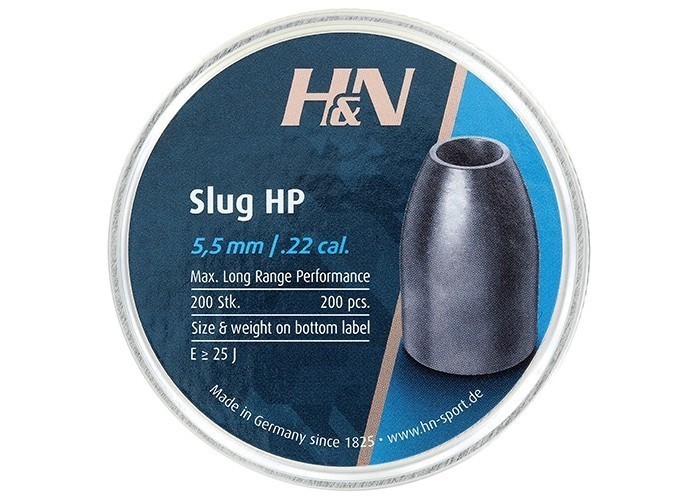
Air pistols almost always use pellets – small, diabolo-shaped lead projectiles. While air rifles can also use slugs (solid projectiles), slugs are designed for high-powered air rifles and long-range use. For air pistols they offer no real advantage, so pellets remain the sensible choice.
Flat-headed pellets are ideal for short distances and produce clean, round holes on paper targets, making them perfect for air-pistol shooting. Domed pellets tend to offer better consistency at slightly longer ranges, while hollow-point pellets deliver greater impact. Pointed pellets provide the best penetration.
There are two additional types of projectiles worth mentioning for completeness. Round lead balls are inexpensive, but generally less precise than pellets. They should only be used in barrels with rifling if made of lead, as steel versions can damage the rifling; steel balls are suitable only for smoothbore barrels. Those smoothbore barrels can also be used with ‘darts’ – small projectiles with a steel tip and a feathered tail, often used for light, recreational shooting at dartboard-style targets.
Loading...